
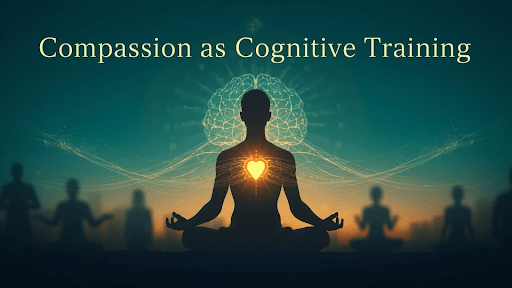
In contemporary mental health discourse, compassion is often viewed as an emotional virtue. Yogic philosophy, however, treats karuṇā not merely as sentiment, but as a disciplined mental cultivation. In an era marked by anxiety, emotional exhaustion, and social fragmentation, the deliberate training of compassion may represent a powerful cognitive intervention. Rather than weakening the individual, compassion—when properly understood—strengthens psychological resilience and emotional regulation.
The Yoga Sutras of Patanjali (1.33) proposes maitrī, karuṇā, muditā, and upekṣā as methods to stabilize the mind. Here, karuṇā is not reactive sympathy but a regulated, intentional orientation toward suffering. It prevents emotional reactivity while maintaining sensitivity. From a cognitive standpoint, this reframes compassion as attentional training—redirecting mental patterns away from judgment, hostility, or indifference, and toward balanced responsiveness.
Neuroscientific research supports this perspective. Compassion-based meditation practices have been associated with activation in brain regions linked to empathy, emotional regulation, and executive control. Structured compassion training appears to strengthen neural networks involved in prosocial behavior while reducing stress reactivity. Importantly, compassion differs from emotional contagion; it engages regulatory circuits rather than overwhelming affective pathways. This distinction is crucial in preventing empathy fatigue, particularly among healthcare professionals and caregivers.
Psychologically, karuṇā fosters adaptive coping. Individuals trained in compassion demonstrate improved resilience under stress, reduced rumination, and enhanced interpersonal relationships. By cultivating a stable internal response to external suffering, compassion interrupts maladaptive cognitive loops such as anger, resentment, and self-criticism. In therapeutic contexts, compassion-focused practices are increasingly integrated into interventions for depression, trauma, and anxiety disorders.
From a yogic lens, compassion also refines the subtle body. Practices centered around the heart space—often associated with Anāhata—combine breath regulation, awareness, and intentional cognition. Slow breathing enhances vagal tone and supports autonomic balance, creating physiological conditions that reinforce emotional stability. Thus, compassion is not abstract morality; it is embodied regulation.
For institutions committed to integrative education and research, compassion training offers a bridge between contemplative wisdom and clinical science. Karuṇā, when approached systematically, becomes cognitive training for emotional balance and social harmony. In cultivating compassion, the mind does not become fragile—it becomes refined, resilient, and capable of responding to suffering without losing its own equilibrium.